
 Skip to content
MATTRESS STORAGE & MOVING
To store a mattress, follow its manufacturer’s care instructions, clean it as directed, let it dry completely, and use suitable protective packaging. Keep it supported in its normal flat position in a clean, dry space unless its instructions explicitly permit another arrangement. Avoid placing heavy items on top. Before moving or shipping it, confirm the permitted handling position, packaging and packed dimensions with the transporter.
Manufacturer guidance and carrier limits checked October 28, 2026. Instructions for your exact model take priority.
A mattress waiting for move-in day needs a plan for both the time in storage and the trip to its next bedroom. Start with its label and manual: a memory foam, hybrid or spring label alone does not tell you whether that specific mattress can be folded, compressed or stored on an edge.
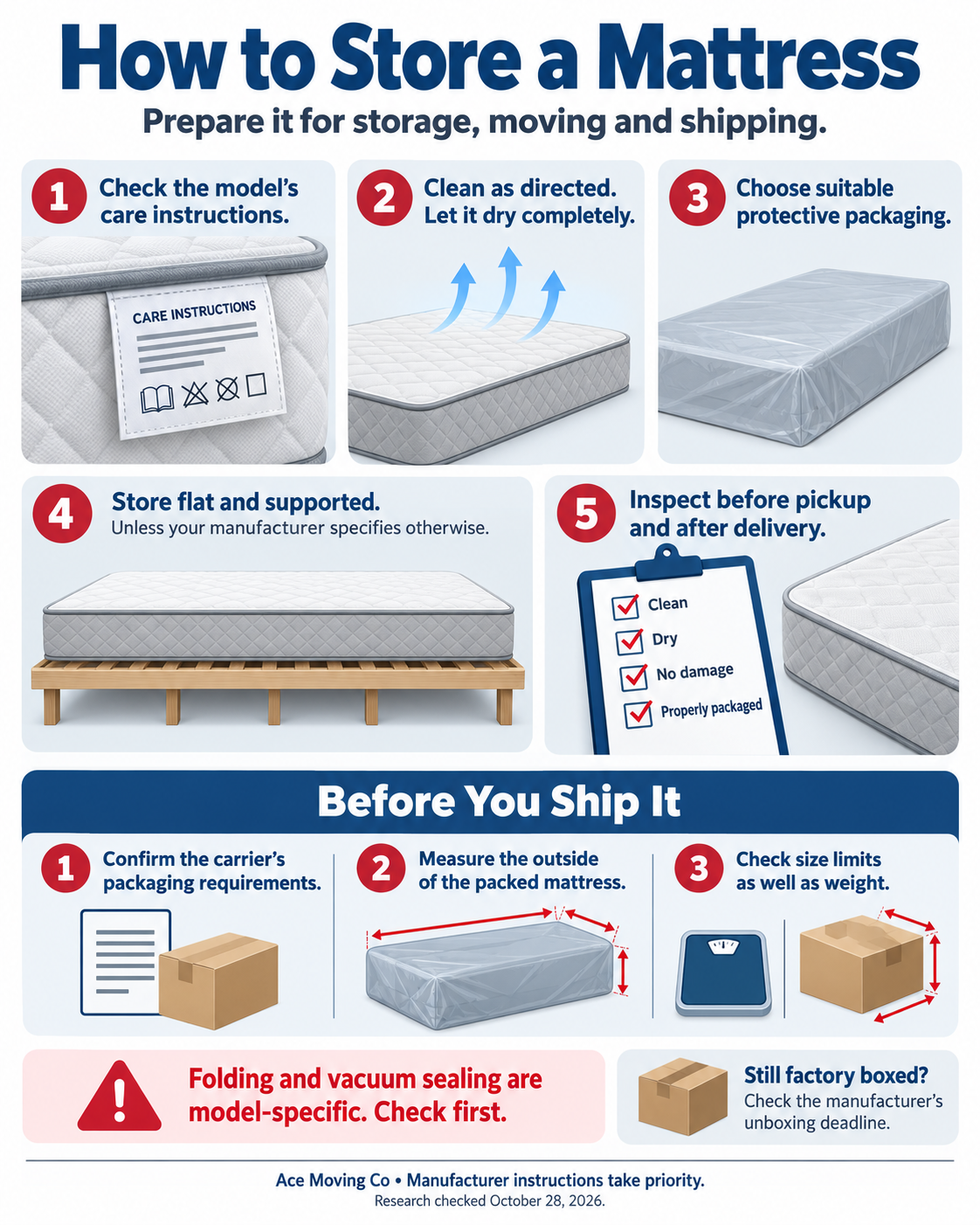
Plan for flat storage unless your manufacturer explicitly allows a different position. Briefly turning a mattress to pass through a doorway is a different decision from leaving it on its side for several weeks. When space is tight, check the instructions before changing its position to fit the room.
| Manufacturer | Published guidance | What to do before moving |
|---|---|---|
| Sealy | Store horizontally, sleep surface up; avoid prolonged upright storage. Plastic wrapping is permitted, but vacuum compression is not. | Leave room for flat storage and share Sealy’s instructions with your packer. |
| Tempur-Pedic | Its moving FAQ permits folding with the sleeping surface inward. If cold conditions leave it folded, allow it to recover naturally instead of forcing it open. | Use the moving exception only as directed; it is not a long-term folded-storage instruction. |
| Purple | Its folding guide allows brief folding for moving and emphasizes checking construction and manufacturer recommendations. | Confirm that the guidance applies to your model before arranging a fold or roll. |
Ask for help identifying the mattress if its label is missing. A storage layout that depends on bending an unidentified mattress is a poor place to start.
Choose protection for the actual job. A cover sold for everyday use, a storage bag and an approved shipping package can have different requirements. Read the product description rather than relying on the words “mattress bag” alone.
Check fit, closure and compatibility with the care instructions. Ask how the covering should be used over the expected storage period. Do not assume all covers are breathable, waterproof or pest-proof.
Ask the selected mover or carrier what protection it accepts and who provides it. A bag does not automatically replace a required carton, protective outer layer or supported transport arrangement.
Measure thickness as well as length and width before buying packaging. Keep adhesive off the mattress fabric, follow the packaging maker’s closure instructions, and label the exterior so the destination room is clear.
Do not mistake wrapping for vacuum sealing. A protective covering and compressing the mattress are separate choices. Get model-specific approval before removing air or reducing its shape.
Choose a clean, dry space with suitable support and enough room to handle the mattress without forcing a bend. A spare room, garage or rented unit should be evaluated for its actual conditions, access and storage layout.
For rented storage, ask what “climate controlled” includes. Public Storage notes that conditions can vary by facility and unit. Confirm temperature and humidity provisions for the specific space instead of assuming the label promises a fixed range.
A standard queen is 60 × 80 inches, according to Sealy’s size guide. Its bare flat footprint is about 33.3 square feet: 60 × 80 ÷ 144. A nominal five-foot width is also 60 inches, leaving no width allowance for that example. Confirm actual usable space, packaging and entry clearance before booking.
If the storage gap depends on a delayed closing or handover, use our move-in delay and storage planning guide to coordinate pickup and delivery dates.
Confirm the service and packaging before you wrap the mattress. Explain whether it is joining a household move, traveling separately or waiting in storage first. Give the provider its model, current condition, approximate size, pickup and delivery locations, and dates.
Keep fresh bedding accessible for the first night. Our packing guide for a household move explains how to organize the rest of your belongings around the move-day schedule.
| Situation | Confirm first | Next action |
|---|---|---|
| Storage before moving | Model instructions, support, environment and cover suitability. | Plan the storage position and inspect again before pickup. |
| Household move | Packing scope, loading position and access at both addresses. | Include the mattress and separate bed components in the inventory. |
| Separate shipment | Accepted packaging, packed size, weight and delivery service. | Obtain a service-specific quote before purchasing packaging. |
| Still factory boxed | Delivery date, unboxing guidance and purchase terms. | Check the deadline before leaving it boxed until move-in. |
Check size limits as well as weight. FedEx’s published Ground limits are 150 pounds, 108 inches in length and 165 inches in length plus girth. All applicable limits must be met.
L + 2W + 2H
80 + 120 + 24 = 224 inches
This illustrative package exceeds the 165-inch combined limit even if its weight is below 150 pounds. Use the actual exterior measurements, with the longest side as length; packaging may add size.
Ask about an appropriate household-goods or freight service if the packed mattress does not qualify. Do not compress it simply to meet a parcel limit. Different services have different requirements, and a factory-boxed mattress is a different package from an already expanded one.
Only when the instructions for your specific mattress permit the proposed handling. Brief folding, rolling, vacuum compression and long-term storage are separate decisions. Permission for one does not establish permission for the others.
If a route through the house appears to require bending the mattress, stop and confirm the model guidance and access plan with the mover. Do not assume that being sold originally in a compressed box means it can be repacked that way at home.
For an opened mattress, follow the model’s storage instructions and reassess its environment and condition if the timeline changes. Do not treat a generic number of months as a guarantee that every mattress will remain in good condition.
A new mattress still in its factory box has a separate deadline to check. Moving delays do not automatically pause the manufacturer’s instructions or purchase terms.
Serta recommends opening within 3–4 weeks and advises against keeping the mattress boxed beyond 12 weeks because full expansion may be affected. This is product guidance, not a universal warranty rule.
Nectar’s policy effective July 28, 2026 starts the trial on delivery. Under that policy, failing to open the mattress within 90 days makes it ineligible for returns and warranty claims. Check the terms that apply to your purchase and seller.
Keep the delivery date and model information available. If move-in is postponed, contact the seller before the relevant deadline rather than waiting until the box reaches the new bedroom.
Inspect the outer package before opening it, then check the mattress where you can see its surfaces and seams. Compare its condition with your earlier photographs and follow the manufacturer’s setup instructions.
Do not assume that every delivered mattress needs the same recovery period. The model’s instructions and how it was transported determine the next step.
Compare the additional cost of keeping this mattress with the delivered cost of a suitable replacement. Its condition, your preference for it, access at the destination and expected storage time all matter.
Keep-and-move cost: additional storage + packaging + additional transport + applicable handling charges.
Replace cost: suitable replacement + delivery and setup + removal of the old mattress, where applicable.
If you already have a household shipment booked, ask what including the mattress adds to that quote. A separate shipment may have a different price structure. Request the scope in writing, including packing, collection, delivery access and any storage gap.
There is no reliable quote without shipment details. For a broader decision framework, see whether to move furniture or replace it after moving.
Only if the space and storage arrangement meet the mattress manufacturer’s instructions. Evaluate dryness, environmental conditions, cleanliness, support and access. A garage’s suitability depends on its actual conditions, not simply its name.
Not automatically. Confirm the selected carrier’s packaging requirements before buying a bag. A service may require additional outer protection, a carton or another packing arrangement, and the final package must meet its size and weight rules.
Confirm the allowed transport position for the exact model with the manufacturer and mover. A short handling maneuver is different from extended storage, so do not use temporary transport permission as a long-term storage rule.
Check the unboxing guidance and purchase terms first. The delivery date may start a trial or other deadline even if you have not moved in. Ask the seller what to do when your moving schedule extends beyond that deadline.
Share its model, dimensions, pickup and delivery locations, and any storage gap with Ace Moving Co. Confirm the packing and transport requirements as part of your household moving plan.
Plan your long-distance moveManufacturer guidance and service limits were checked on October 28, 2026. Policies can change; use the instructions and terms applicable to your model, purchase and shipment.